Computing the boundary complex using Macaulay2
2023-05-08
Suppose you are given a divisor
- For each
- For each non-empty intersection
From this boundary complex, interesting information about the divisor
When working in the projective plane
Here is some Macaulay2 code that will compute the boundary complex in this case:
boundaryComplex = method()
boundaryComplex := listOfDivisors -> (
-- Helper function, takes list of polynomials and determines
-- if their intersection is irrelevant ideal
intersectionIsIrrelevantIdeal = s -> (
radical(ideal(s)) != ideal(y_0,y_1,y_2)
);
-- Select all possible subsets of divisors
rawPolySubs = subsets(listOfDivisors);
polySubs = rawPolySubs_{1..(#rawPolySubs-1)};
-- Create a true/false mask for when this intersection is the irrelevant
-- ideal and hence those divisors do not intersect in projective space
mask = apply(polySubs,intersectionIsIrrelevantIdeal);
-- List all faces
R=QQ[x_0..x_(#listOfDivisors-1)];
-- take subsets of numbers 0 through length(listOfDivisors), then
-- drop the first as it is always the empty set
faceNums = drop(subsets(toList(0..(#listOfDivisors-1))),1);
faceSubs = drop(subsets(toList(x_0..x_(#listOfDivisors-1))),1);
-- Filter by the mask
faceMonomials = {};
faceList = {};
for i in 0..(#faceSubs-1) do (
    if mask#i then (
        faceMonomials=append(faceMonomials,fold((i,j)->i*j, faceSubs#i));
        faceList=append(faceList,faceNums#i);
    )
);
(simplicialComplex(faceMonomials),faceList))
The function outputs two objects:
- First, a
SimplicialComplexobject, which is exactly - Second, a list of the faces of this simplicial complex as subsets of the integers
Polymake
It should be a straightforward matter to generalize this to divisors on other varieties, say in the
toric setting, by changing the irrelevant ideal
An example run of this code is given as follows:
S = QQ[y_0..y_2]
l0 = y_0
l1 = 2*y_1-y_2+y_0
l2 = y_2
c1 = y_0*y_1 + y_0*(y_2 - y_0) + y_1*(y_2 - y_1)
c2 = y_0*y_1 + y_0*(y_2 - 3*y_0) + 3*y_1*(y_2 - 3*y_1)
listOfDivisors = {l0,l1,l2,c1,c2}

(bc, lf) = boundaryComplex(listOfDivisors)
Moreover, using the Visualize package, we can quite easily visualize two-dimensional simplicial complexes (three-dimensional are per now not supported). In the above example this would proceed as follows:
loadPackage "Visualize"
openPort("8090")

visualize bc

closePort()
(Remember to close the port after you are done, if you forget, you might need to use lsof -i tcp:8090 and kill the process holding onto the port).
This should give you a nice interactive browser animation, looking similar to the following image:
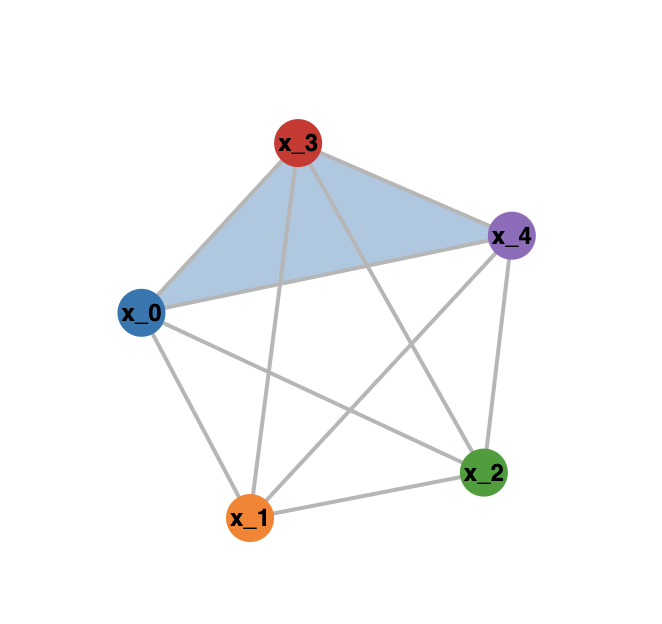
For three-dimensional simplicial complexes, the following code will transform the list lf into a string which can be pasted in polymake to create the corresponding polymake simplicial object:
facesToPolymakeSimplicialComplex = method()
facesToPolymakeSimplicialComplex := lst -> (
listStr = toString(lst);
listStr = replace("{","[",listStr);
listStr = replace("}","]",listStr);
out = concatenate({"$s = new SimplicialComplex(INPUT_FACES=>",  listStr, ");"});
out
)

facesToPolymakeSimplicialComplex(lf)
This can then be visualized using the command $s->VISUAL;
Bibliography:
- Grayson, Daniel R. and Stillman, Michael E., Macaulay2, a software system for research in algebraic geometry, http://www.math.uiuc.edu/Macaulay2//
- Ewgenij Gawrilow and Michael Joswig, polymake: a framework for analyzing convex polytopes, https://polymake.org/doku.php/startt